A short walk to a quiet cascade
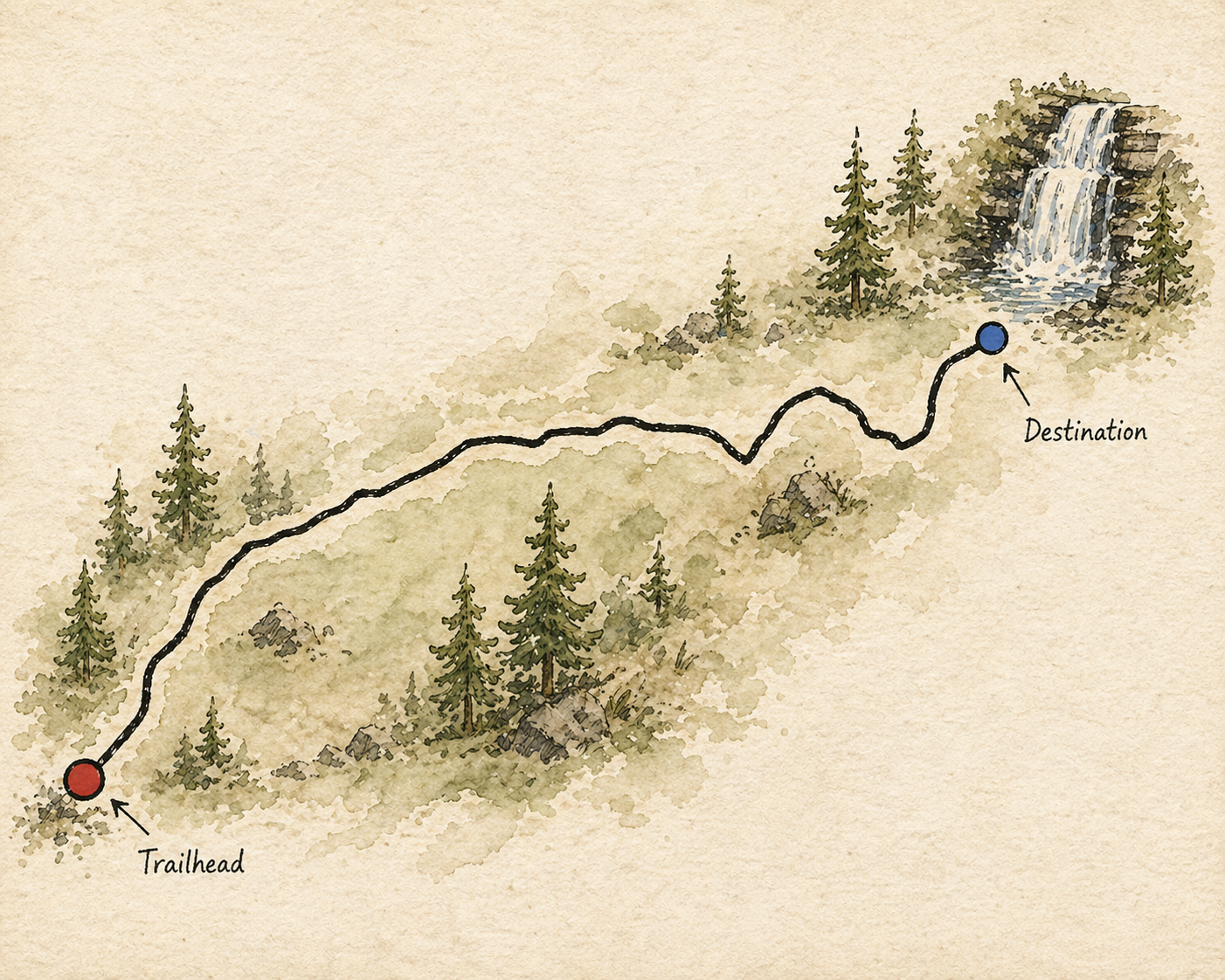
1.9 miles round-trip from Three Forks to the falls, most of it under rhododendron cover.
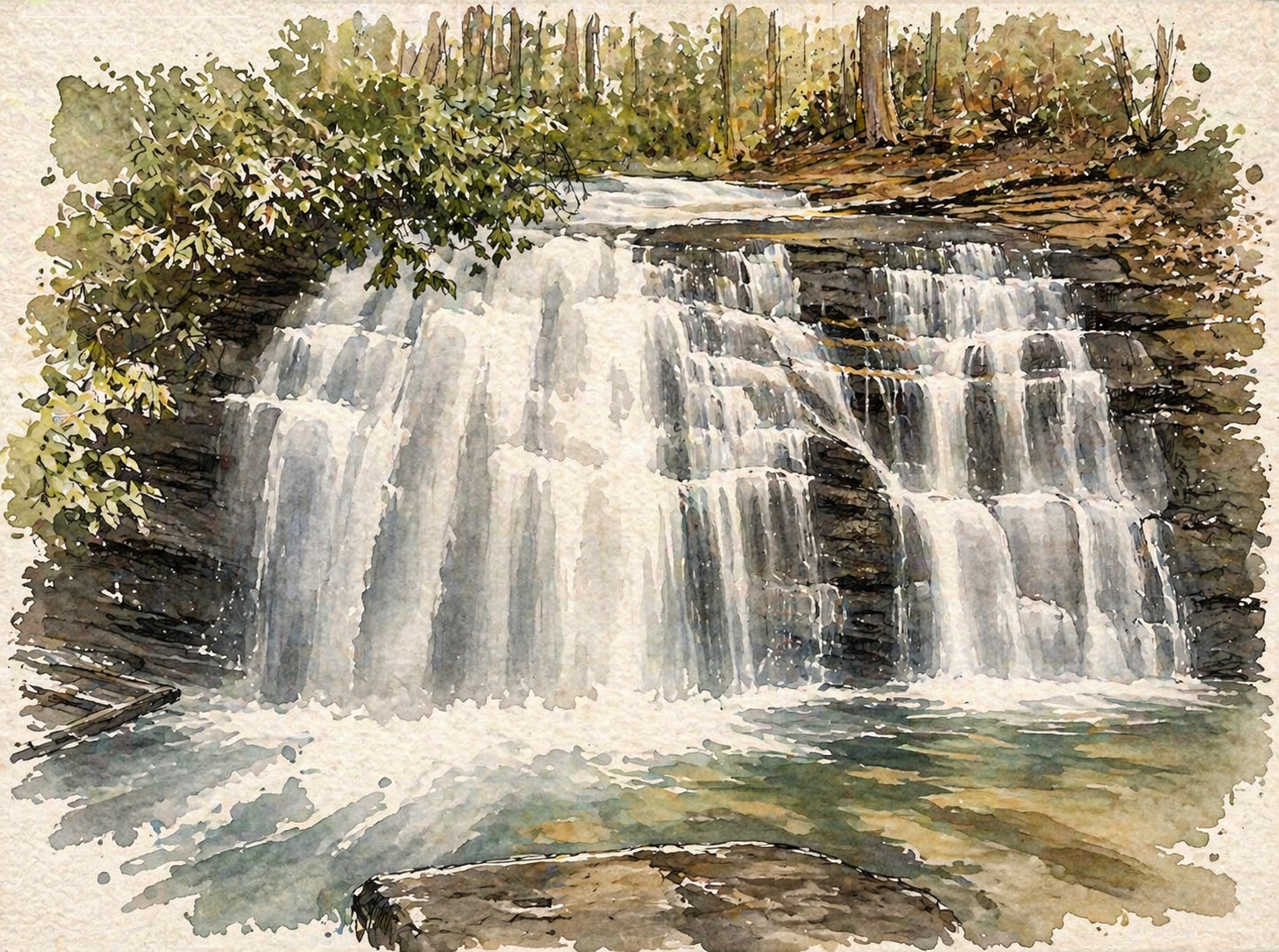
Long Creek Falls sits a little less than a mile up the Benton MacKaye Trail from a gravel clearing called Three Forks, where the Appalachian Trail and the Benton MacKaye Trail part ways for good. The walk is short, roots and rocks underfoot, a gentle climb that most hikers finish in under an hour one way. The payoff is a two-tier waterfall, roughly fifty feet total, set back in a rhododendron bowl.
The trail is shared with the AT for the first third of a mile, then the two paths separate at a small wooden sign where the white blaze heads north toward Springer Mountain and the blue-and-white diamond of the Benton MacKaye continues east toward the falls.
Three Forks
A gravel clearing where Long Creek, Chester Creek, and Stover Creek meet. Room for a dozen cars, a wooden kiosk at the north end, no facilities. Cell service drops off here.
Long Creek alongside
The trail runs wide and flat beside Long Creek for a quarter mile. Hardwood canopy overhead, mountain laurel on the banks, a few flat rocks that make decent lunch spots if you are pacing yourself out rather than in.
Where the blazes meet
The white blaze of the Appalachian Trail meets the blue-and-white diamond of the Benton MacKaye. They share tread for about three-tenths of a mile. A small wooden sign at the junction points north to Springer Mountain, two miles back.
Rhododendron tunnel
The trail narrows into a rhododendron tunnel, green even in winter. You hear the falls before you see them. A wooden sign on the left marks the short spur down to the viewing area.
Long Creek Falls
Two tiers, roughly fifty feet total. Water slides down a mossed shelf, pools briefly, then drops again to a shallow basin you can wade. A side trail on the right climbs to an overlook at the top of the upper tier. Worth the thirty seconds.
Why the falls are here
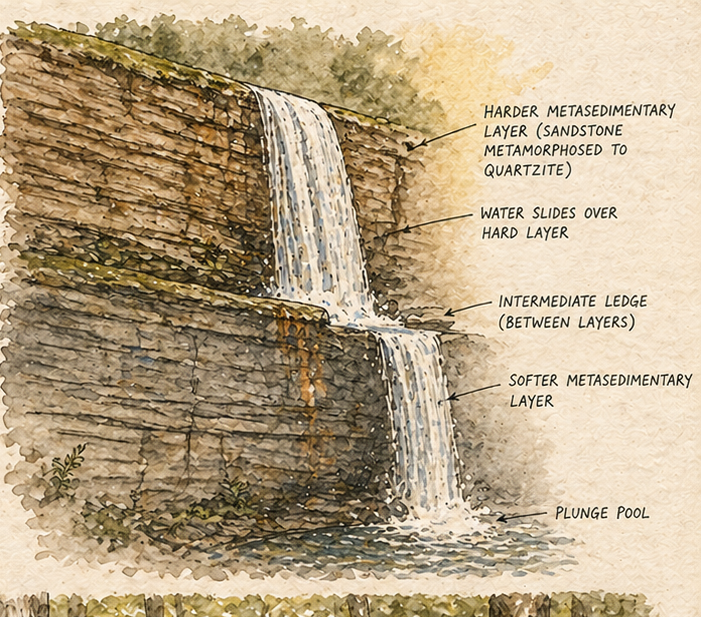
A harder layer meets a softer one. Water exploits the seam.
Long Creek Falls drops over Great Smoky Group metasandstone, the same rock shelf that shapes most cascades in the southern Blue Ridge. The two-tier form is a weathering pattern. A harder band of quartzite near the top resists erosion, then softer metasedimentary rock below gives way, and the creek exploits the seam.
The rock is about 550 million years old, laid down when the southern Appalachians were still a shallow sea floor. Tectonic pressure folded and cooked the sandstone into quartzite, then uplift and erosion exposed it. The orange staining on the cliff face is iron oxide leaching from the rock. The green is moss and lichen colonizing the damp mineral surface.
The plunge pool is shallow because the falls are relatively young in geological terms. Bigger falls carve deeper pools over time. Here the current is still working on the second tier.
What grows here
Second-growth cove hardwood, dense rhododendron understory, a creek corridor.
The forest along the trail is second-growth southern Appalachian cove hardwood. The canopy is dominated by tulip poplar, American beech, red maple, and scattered black gum. Eastern hemlock is present where the hemlock woolly adelgid has not yet taken them, though their numbers are thinning year over year.
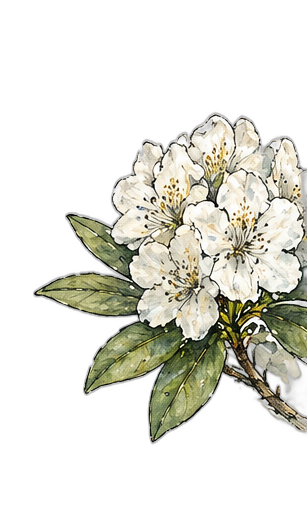
Rhododendron maximum dominates the understory, which is why the final approach to the falls feels enclosed and green even in January. This shrub blooms white in late June and early July, making the tunnel briefly spectacular. Mountain laurel is common on the drier slopes just above the creek.
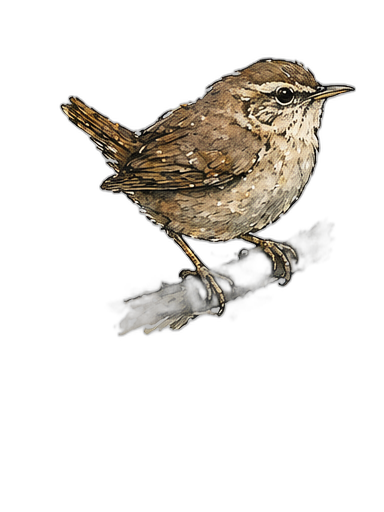
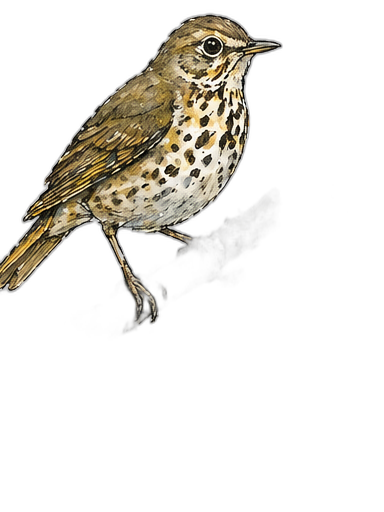
On the damp rocks near the falls themselves you will find rockcap fern, walking fern, and liverworts. Spring ephemerals along the trail include trillium, wild geranium, and foamflower in April. Wood thrush and ovenbird are the signature summer voices. In winter, listen for the winter wren near the cascade.
Month by month
Flow is strongest in spring. Each season has its own texture.
Quiet notes from the field
The small things that are easy to miss on a first visit.
The overlook spur
A faint side trail on the right at the main viewing area climbs to the top of the upper tier. Thirty seconds up, a better angle down the full cascade.
The junction kiosk
At the AT-BMT junction, a small trail register is bolted to the kiosk. Worth signing if you enjoy knowing who else was here yesterday.
Flat lunch rocks
Halfway in, the creek widens over a flat shelf of exposed rock. Good midway snack spot, drier than the falls themselves in summer.
Early light
The viewing area catches morning sun on the upper tier for about an hour after 9 AM in April. Best rainbow window.
Winter wren
Listen for the metallic song of the winter wren near the falls in cold months. One of the loudest songs per gram of bird in North America.
The other Three Forks
The trailhead is named for the meeting of Long Creek, Chester Creek, and Stover Creek. You can walk thirty yards south of the lot to see them joining.
From Blue Ridge, Georgia
Thirty minutes by car, five of it on gravel. No reservation needed.
Frequently asked
The practical stuff people want to know before they drive out.
How long is the hike to Long Creek Falls?
1.9 miles round-trip from the Three Forks trailhead, with roughly 337 feet of elevation gain. Most hikers finish in 60 to 90 minutes including time at the falls.
Is Long Creek Falls dog-friendly?
Yes. Dogs are permitted on leash throughout the Chattahoochee National Forest. The shallow pool at the base of the falls is safe for dogs to wade in low flow.
Can you swim at Long Creek Falls?
The plunge pool is small and shallow, better for wading than swimming. Rocks at the base are slippery when wet. Never climb above the falls; there is no safe route up the rock face.
When is the best time to visit Long Creek Falls?
February through May, when spring rainfall produces peak flow. Late winter often shows partially frozen cascades, which are arguably the most beautiful. Summer flow is thin but the forest is lush and the swimming pool is more inviting. October brings fall color, though the creek is at its lowest of the year.
Is Long Creek Falls on the Appalachian Trail?
The trail to the falls shares tread with the Appalachian Trail for roughly three-tenths of a mile. The waterfall itself sits a short spur off the Benton MacKaye Trail, which splits off at the junction. Thru-hikers often stop here on their way north from Springer Mountain.
How tall is Long Creek Falls?
Roughly 50 feet total across two tiers. The upper tier drops about 30 feet into a brief catchment pool, then the lower tier slides another 20 feet into the plunge basin.
Is there a fee to visit Long Creek Falls?
No. Access is free and no permit or reservation is required. This is one of the few nearby waterfalls in north Georgia without a parking fee.
Is cell service available at the trailhead?
Cell service drops off along FS-58 and is generally unreliable at Three Forks. Plan for offline conditions once you leave Doublehead Gap Road. Download maps ahead of time if you rely on them.
Other waterfalls in the area
All within an hour of Three Forks.
Fall Branch Falls
Two-tier roadside waterfall, 80 feet, short 0.2-mile walk from the pullout.
55 min drive, southAmicalola Falls
Seven-tier, 729 feet. Tallest cascading waterfall east of the Mississippi.
45 min drive, eastDesoto Falls
Three separate falls along a 2-mile loop in Chattahoochee NF.